On 11 May 2026, I delivered a guest lecture to the MBA program at Shih Chien University on strategic resilience in the Gulf. The discussion connected regional security with a practical question for governments and businesses: how can systems keep functioning when the assumptions behind them break down?
Drawing on my background growing up in Saudi Arabia and my studies in political economy, I approached the subject as both a regional and a personal concern. Geopolitical uncertainty affects investment, professional opportunities, and confidence in the future. Understanding resilience means looking at the institutions and everyday services that allow a society to continue operating under pressure.
Resilience as a strategic objective
The presentation’s central argument was that resilience requires reducing dependence on any single route, supplier, or external partner. Systems designed solely around low costs and smooth conditions can become vulnerable when a disruption reaches their most concentrated point.
I used the deck’s discussion of past Gulf security shocks to frame this problem. The analytical focus was the relationship between vulnerability and policy choices: how exposure to disruption can encourage investment in alternatives, domestic capabilities, and more flexible international relationships.
This creates a difficult trade-off. Spare capacity and backup arrangements cost money, even when they are not used. Their value becomes clearer when a disruption threatens production, transport, or essential services. For policymakers and managers alike, resilience requires judging that cost against the consequences of losing access altogether.
Logistics: production needs a route to market
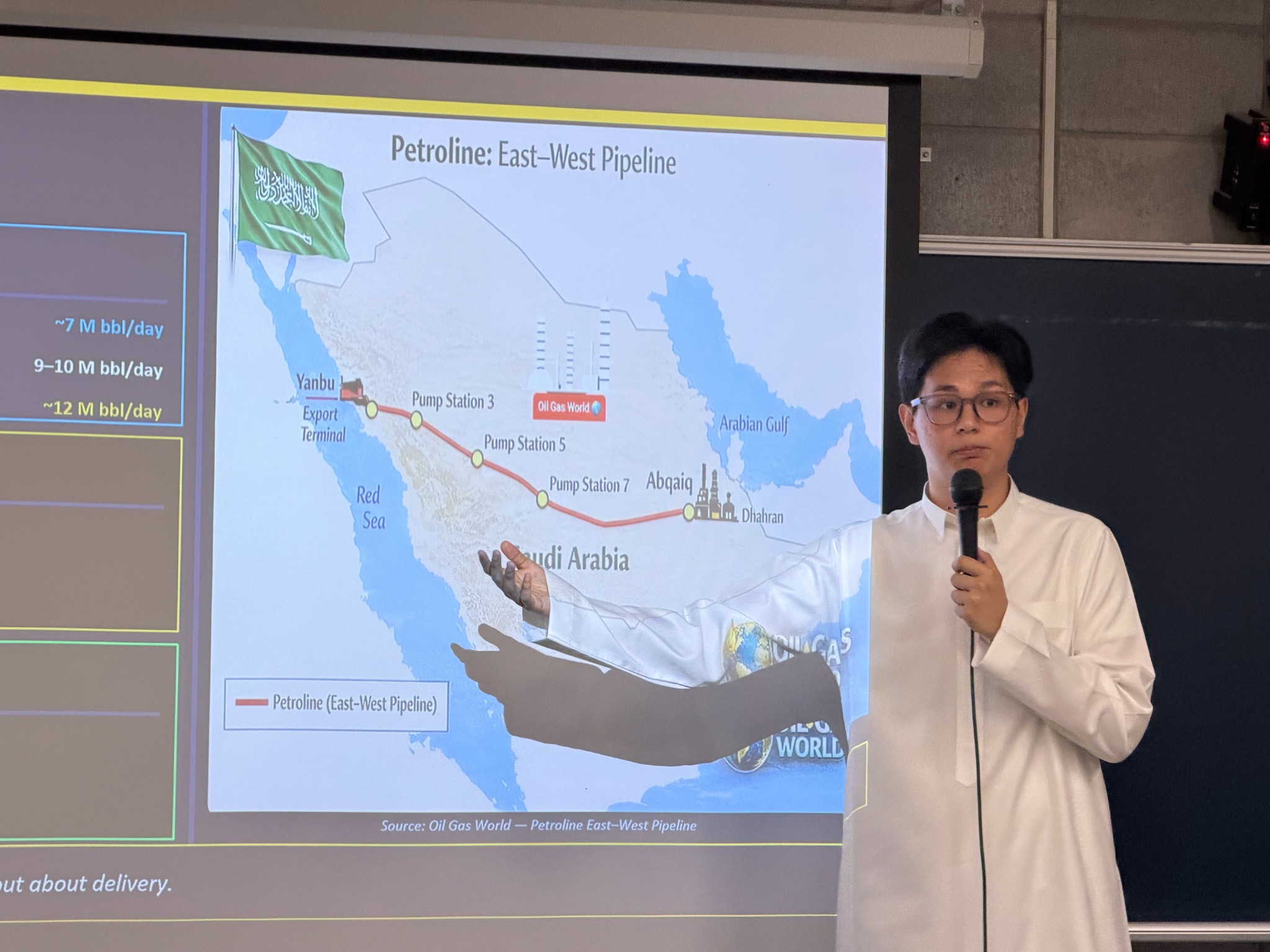
The lecture examined Saudi Arabia’s East–West Pipeline as an example of the strategic value of alternative export routes. The broader point was that productive capacity has limited value if goods cannot reach customers. Transport routes and access to ports belong at the center of economic-security analysis.
For an MBA audience, this translates directly into supply-chain decisions. A company can ask where its critical dependencies sit, which routes or suppliers could substitute for them, and how quickly it could switch. Diversification is useful only when those alternatives are operationally credible.
Domestic capabilities and essential infrastructure
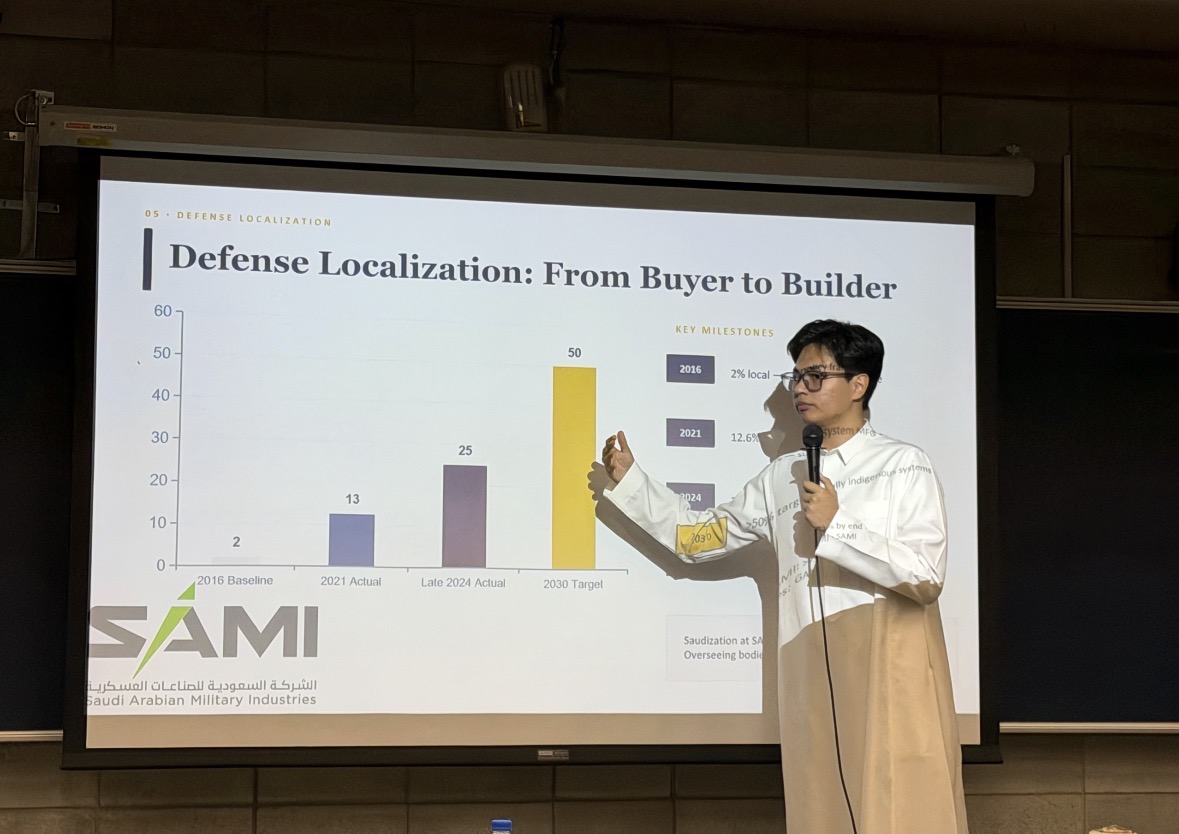
Defense localization formed another part of the discussion. I presented domestic manufacturing, maintenance, and technical expertise as ways to develop capacity beyond purchasing equipment. The economic dimension includes specialist employment and industrial learning, while the strategic dimension concerns the ability to maintain essential systems under external constraints.
The same reasoning extended to civilian infrastructure. The deck considered water supply, food reserves, and digital infrastructure as connected components of national resilience. Distributed systems and reserves can provide options when a major facility or supply route becomes unavailable.
The lecture also treated data and computing infrastructure as strategic concerns. Greater domestic capacity can support continuity and control, but assessing digital resilience requires attention to the equipment, software, power, and expertise on which that capacity depends.
Diplomacy and multiple partnerships
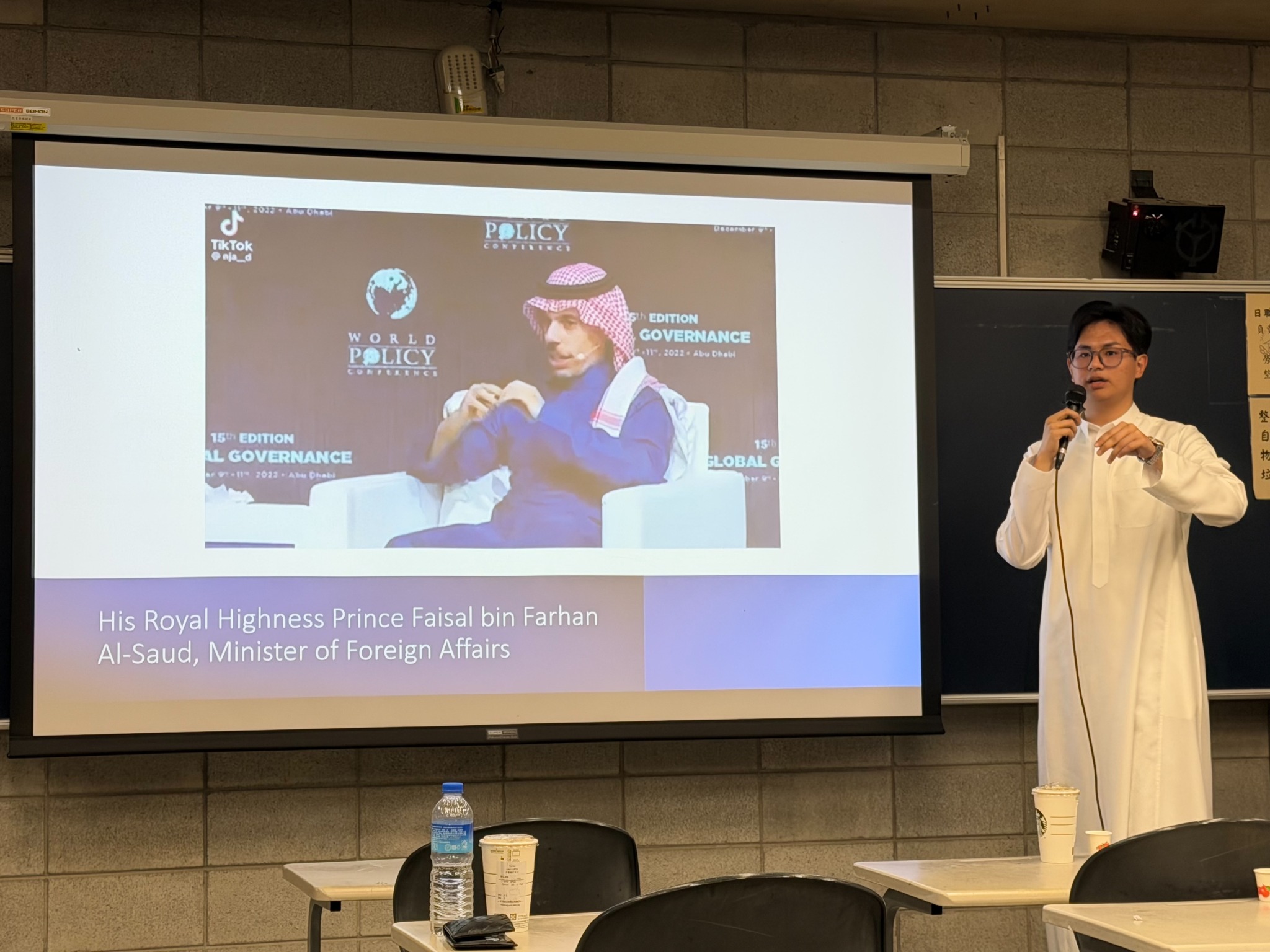
A recurring theme was the relationship between autonomy and international cooperation. I framed strategic autonomy as greater room to make decisions and manage dependencies. The presentation explored how relationships with different partners can serve different economic and security needs.
The discussion of Saudi–Iran relations emphasized the potential value of de-escalation for economic transformation. It also distinguished religious identity from the wider strategic questions of state security, regional influence, and political decision-making. For businesses, the useful task is to identify how those decisions affect trade, investment, and operating conditions.
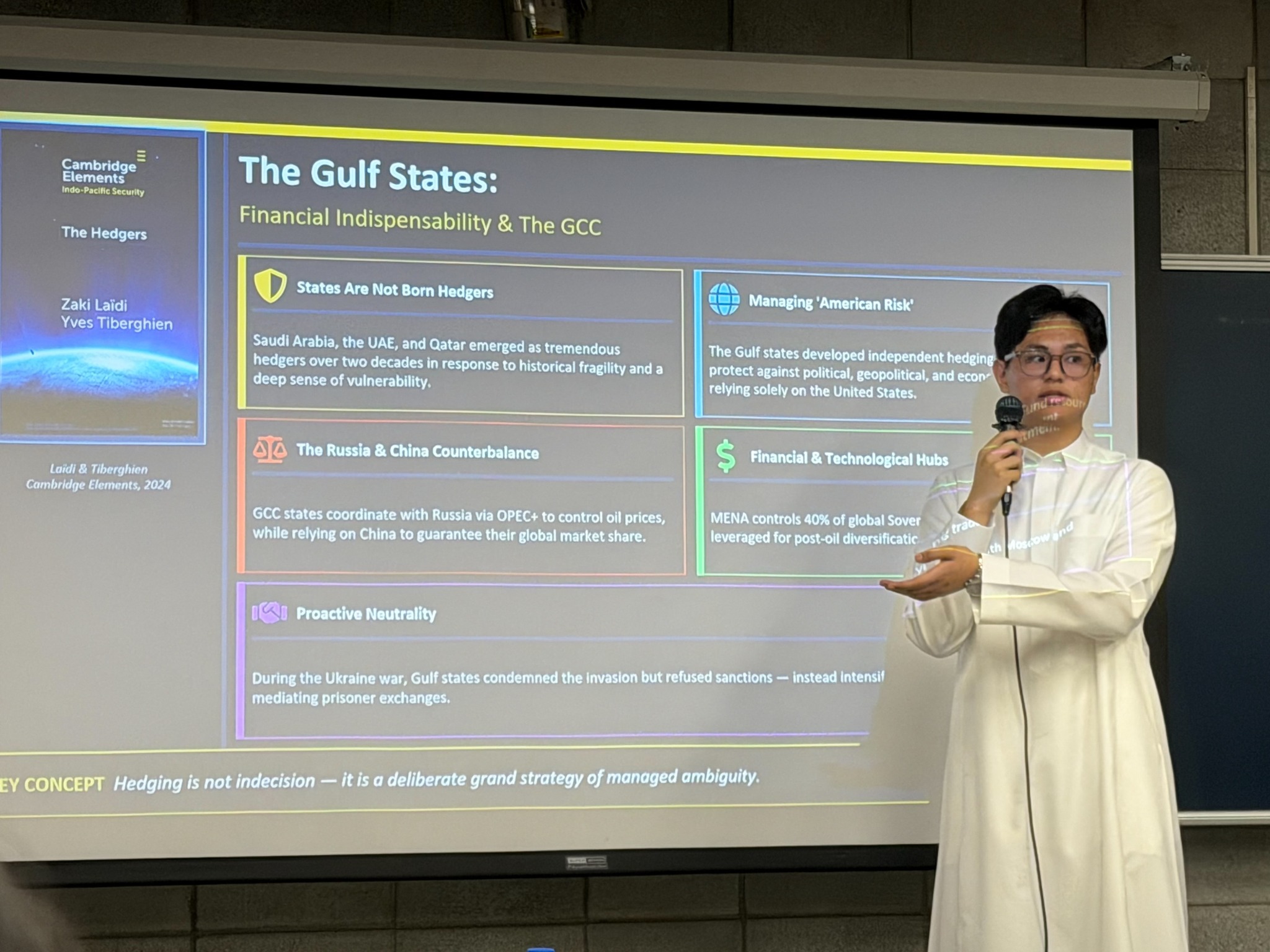
I used the concept of hedging to explain the effort to preserve options across competing relationships. The lecture drew on the deck’s reference to Zaki Laïdi and Yves Tiberghien’s work on hedging to connect this regional discussion with a wider framework for international strategy.
Social foundations and the Gulf as a regional system
The presentation also examined the social foundations of resilience. Concepts including amanah, or responsibility and trust, and maslahah, or public interest, offered a way to discuss the obligations that connect leadership, public services, and society. These ideas formed part of my interpretive perspective on the region.
I then considered the Gulf as a connected system with different national strengths. The UAE’s role in international connectivity and finance provided a comparison with Saudi Arabia’s emphasis on energy and industrial development. The purpose was to show why regional resilience cannot be understood through a single country or a single sector.
What this means for international business
The final part of the lecture connected these themes to business strategy. Geopolitical exposure should enter decisions about location, financing, and supply chains early enough to influence their design. A disruption can affect delivery times and insurance costs as well as the availability of energy or imported inputs.
The central questions for managers are practical: which dependencies could interrupt operations, what alternatives are available, and how much flexibility is worth paying for? Scenario planning can help reveal these vulnerabilities without assuming that a single forecast will prove correct.
My closing argument was that the Gulf’s future should be understood through its capacity to adapt as well as its exposure to risk. Strategic resilience links security to economic opportunity: the ability to keep investing, learning, and providing essential services even when the regional environment becomes less predictable.